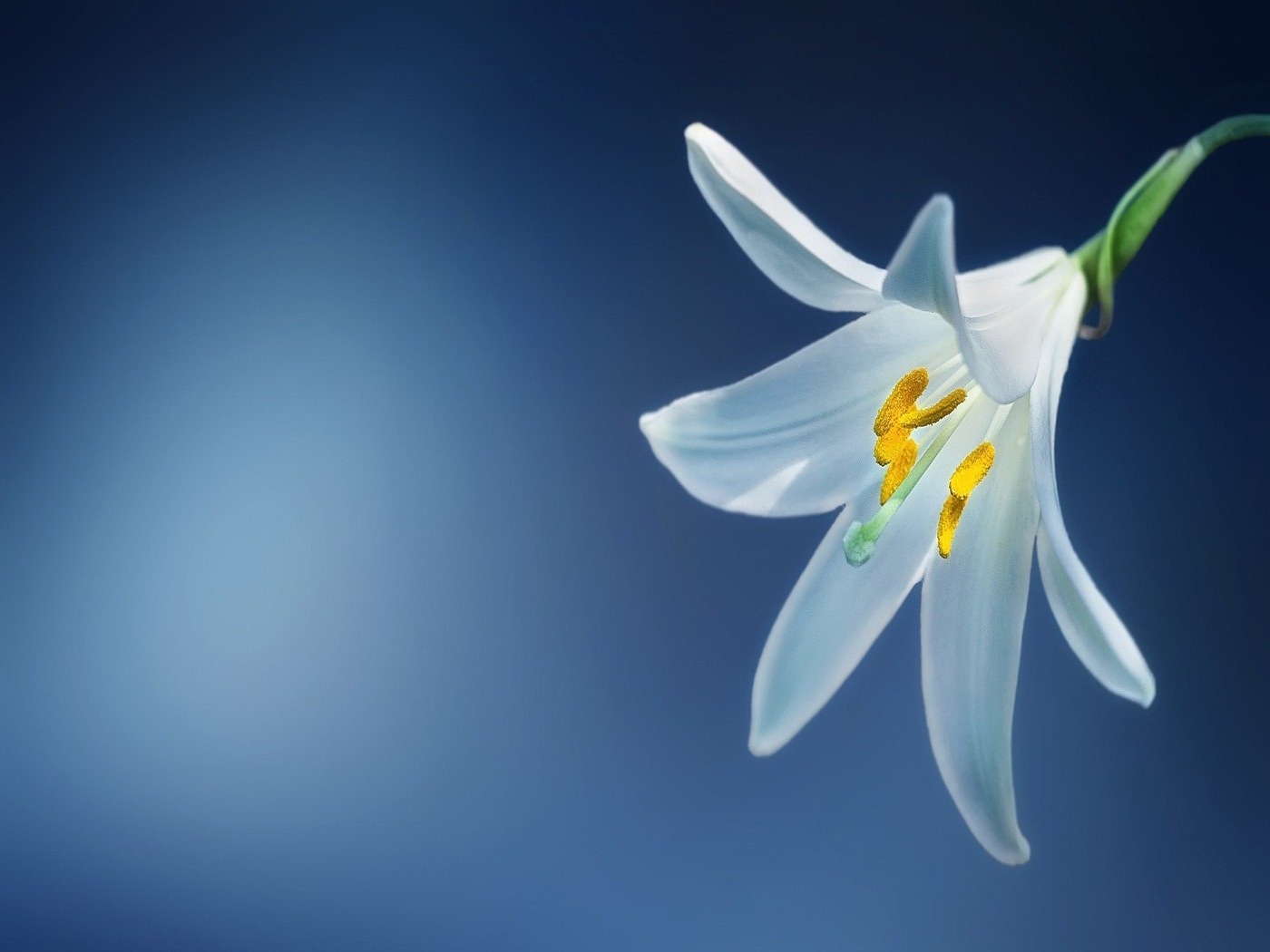
The flower is the most showy part of plants. We find flowers only in angiosperms, the most evolved plants in the plant kingdom. Plantae. Most flowers possess four types of structures:
- Sepals
- Petals
- Stamen or androceo
- Pistil or gynoecium
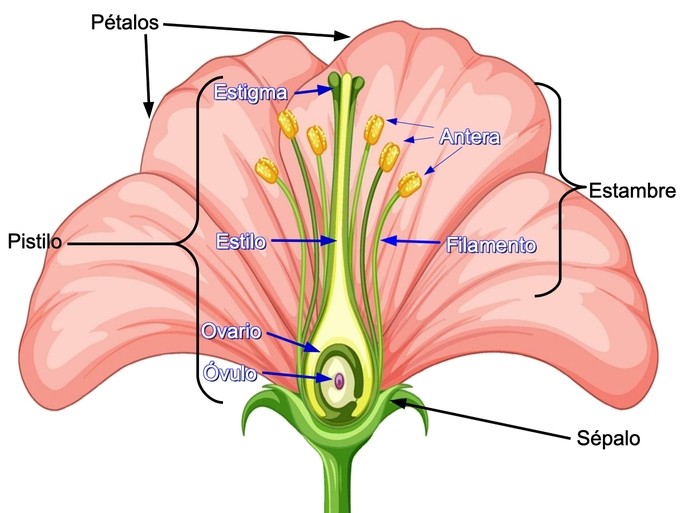
When a flower has all these structures, they are said to be complete flowers, for example, lilies. On the contrary, flowers such as begonia, which do not have petals, or other flowers that do not have any of the parts, are called incomplete flowers.
| Flower parts | Characteristics | Functions |
|---|---|---|
| Sépalo | Modified leaves Green color Separate or united |
Protecting the cocoon |
| Petal | Flat and thin Assorted colors Separate or joined |
Attracting pollinators |
| Stamen or androceo | Present in male flowers | Producing pollen |
| Pistil or gynoecium | Present in female flowers | Produce ovules |
Sepals
Sepals are modified leaves that surround and enclose the other parts of the flower as they mature. They are found on the lower, outermost part of the flower and together they form what we know as the calyx of the flower.
Usually, the sepals are green, thick and waxy. When it has a different color, they are known as petaloid, e.g., Jesus cord sage (Salvia leucantha) which has purple sepals.
Its function is to protect the flower bud from attack by bacteria, fungi and insects. It also maintains the humidity inside the flower bud.
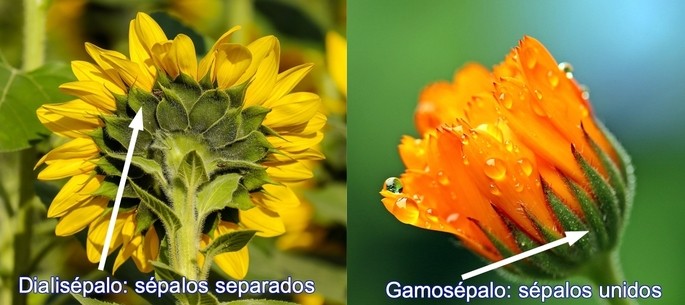
Sepals can be:
- Dialisepaloussepals are separate, as in the sunflower and the rose.
- Gamosepalissepals are fused, as in the case of marigold and sage.
Petals
The petals are the most showy part of the flower. Together they form the corolla of the flower and the sepals and petals together constitute the perianth.
The function of the petals is to attract the right pollinator. For this purpose, different strategies are used, for example, flowers that open at night give off fragrances that attract nocturnal animals.
The petals are characterized by being flat and thin. In addition, they may contain pigments that give them their characteristic colors. These pigments can also absorb ultraviolet light, which insects can distinguish.
Not all flowers have petals. Some are wind-pollinated, such as corn and wheat, so no petals develop, as it would be a waste of plant energy.
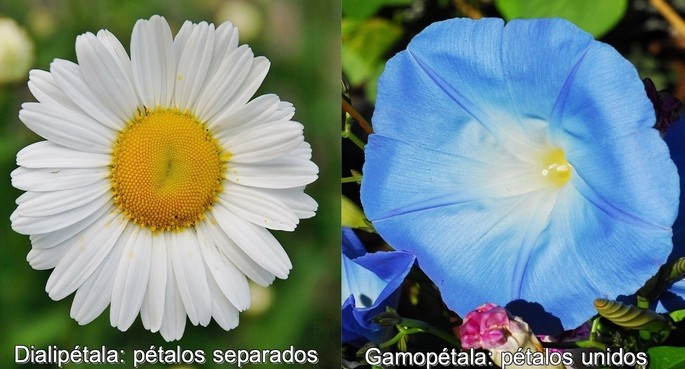
Petals can be:
- Gamopetalpetals appear fused, as in the flowers of the vine Ipomoea and pumpkin.
- Dialypetal: the petals are separate, as in the daisy and the magnolia.
Stamens
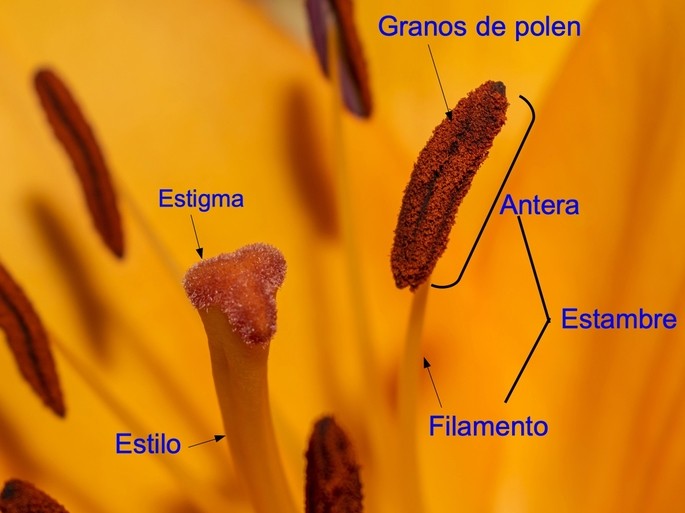
The stamens constitute the androceo or male reproductive organ of the flower. They are formed by a filament, which is inserted on the petal corolla, and a structure called anther.
The anther is where pollen is produced. It is composed of diploid cells, within which are microsporocytes, which then divide by meiosis to produce four microspores. The microspores will give rise to pollen.
Pollen can travel through the air or be carried by pollinators from flower to flower. This is such a resistant structure that it can be used to determine the species of plants that existed thousands of years ago.
Dehiscence is the process by which the anthers open to release pollen.
Pistil
The pistil or gynoecium is the female reproductive organ of the flower. They are also known as carpel and are located in the center of the flower. The pistils have three main parts:
- Stigma: which captures pollen grains.
- Style: support of the stigma that keeps it at a certain height.
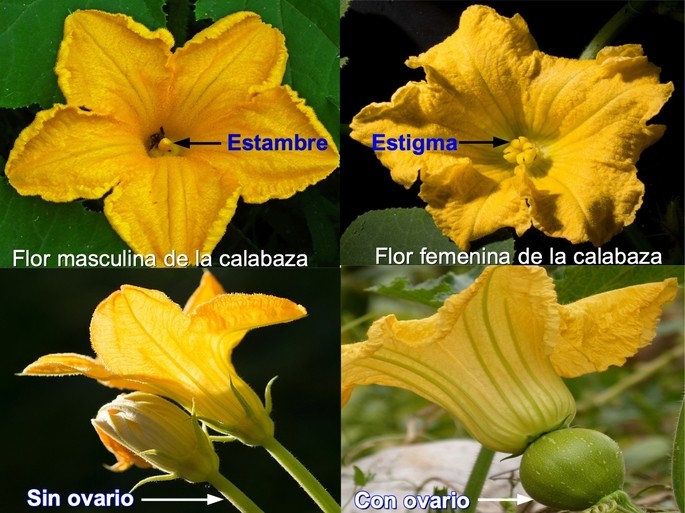
- Ovarywhere megaspores are produced. Inside the ovary is the placenta, where the ovules are found. An ovule develops into a seed after it has been fertilized and the ovary develops into a fruit.
Male and female flowers
Some plants have the female organs in one flower and the male organs in another. This is the case of the pumpkin plant.
You may also be interested in:
References
Mauseth, J.D. (2016). Botany-An introduction to plant biology, 6th ed. Jones & Bartlett Learning. Burlington, MA.
Salvat, J. (editor). (1987). Flower. Enciclopedia Salvat de Ciencia y Técnica (volume 6, pp.1350-1353). Barcelona, Spain.